Global Action for Women Empowerment (GLOWA) as a non-governmental, non-partisan and non -profit making organization was formed in June 1999 in response to the health and socio-economic challenges of women, girls, youth and children in Ghana.
Global Action for Women Empowerment (GLOWA) is a non-governmental organization established in June 1999 to address the health, socio-political, and economic challenges faced by women, girls, and other vulnerable groups in Ghana.
As a Women’s Rights Organization, GLOWA is committed to promoting women’s rights and empowerment. We work as a strong Civil Society Organization, engaging both Rights Holders and duty bearers. GLOWA utilizes behavior change and popular participation approaches to empower grassroots citizens, particularly women and girls, persons with disabilities (PWDs), youth, and marginalized communities, to actively participate in local governance processes.
We empower Rights Holders by linking them with duty bearers, particularly the Metropolitan, Municipal, and District Assemblies (MMDAs), to demand adequate and accessible information, quality delivery of public goods and services, inclusion, participation, and equitable distribution of resources. We leverage legal frameworks such as Article 34 Section 5 of the 1992 Constitution of Ghana, the Local Governance Act, 2016 (Act 936), and other relevant legislation to hold duty bearers accountable and promote inclusivity.
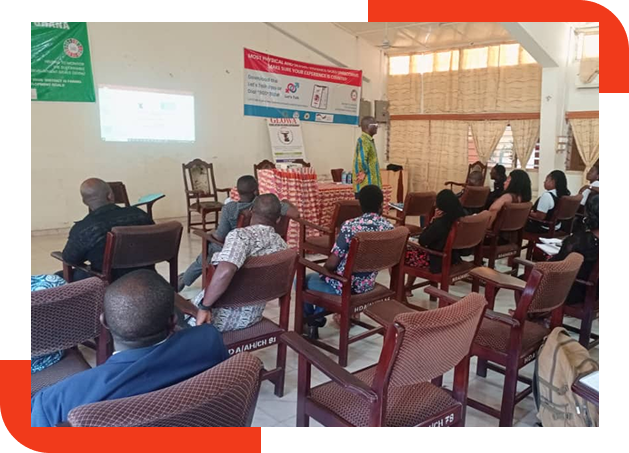
GLOWA conducts capacity building interventions for rural women, market women, smallholder farmers, and other marginalized groups. These interventions provide access to credible information on health, reproductive health, water, sanitation, hygiene, and family planning, empowering them to make informed decisions. Additionally, we address violence against women and girls (VAWG) by equipping them with strategies to increase their voice and agency within their families and communities.
Furthermore, GLOWA supports our primary beneficiaries in initiating or expanding income-generating ventures such as petty trading, farming, fish mongering, oil processing, bakery/pastries, and gari production. These economic empowerment initiatives increase income opportunities and promote equitable resource distribution within families, communities, and districts.
We also sensitize Gender Equality and Social Inclusion (GESI) groups to actively participate in District Assembly and national elections. GESI groups are educated on their rights and responsibilities as voters and aspirants, fostering active civic engagement and representation.
Through our holistic approach, GLOWA strives to create lasting positive change by empowering women, girls, PWDs, and marginalized communities to become active participants in decision-making processes and agents of their own development.
Increase access to rights-based education, vocational skills, and life skills training for women and girls to improve self-efficacy, economic independence, and informed decision-making.
Identify and address specific barriers faced by marginalized subgroups — women with disabilities, rural women, smallholder farmers, in- and out-of-school girls — to promote full participation and rights.
Partner with communities and institutions to promote community-based advocacy and survivor-centered support services that reduce sexual and gender-based violence (SGBV) incidence and improve response mechanisms.
Empower women and girls with entrepreneurial training, financial literacy, access to economic resources including pathways to land, credit, and capital for sustainable livelihoods.
Improve women’s and girls’ access to sexual and reproductive health services, psychosocial and mental health support, nutrition education, and effective health referral systems.
Implement climate-responsive, gender-transformative interventions addressing environmental and climate change, digital inclusion, and other intersectional vulnerabilities affecting women and girls.
Strengthen GLOWA's organizational systems, governance structures, MEL systems, and staff competencies to efficiently and effectively deliver, scale, and sustain programs.
Engage with key stakeholders, including duty bearers, donor partners, academia, Think Tanks, policymakers, philanthropists, and other civil society actors to influence gender-equitable policies, promote inclusive norms, and expand GLOWA's impact and resource base.
GLOWA is headquartered in Ho in the Volta Region of Ghana at Sokode-Lokoe on the Diamond Cement Avenue opposite Catholic Secretariat off the main Ho-Accra Highway. Digital Address: VH-0145-5106. GLOWA also operates project satellite offices closer to project Districts when necessary.
Copyright GLOWA Ghana © 2025 All Rights Reserved. Designed by Askes Media Network
Powered by: TechSoup West Africa